 Unlock
Page: 1
/
14
Total 68 questions
Check Your Knowledge with Adobe AD0-E605 Exam Practice Questions
Transform your career trajectory as a customer data architect with our comprehensive AD0-E605 practice materials, designed specifically for ambitious Adobe Real-Time Customer Data Profile Developer Expert candidates. We understand the pressure of validating your expertise in identity resolution, data governance, and audience segmentation—skills that Fortune 500 companies desperately need. Our triple-format delivery system (PDF for on-the-go review, web-based for instant access, desktop software for realistic simulation) mirrors actual exam conditions while adapting to your learning rhythm. Join the elite community of certified professionals commanding premium salaries in martech, leveraging technologies like Adobe Experience Platform, Journey Optimizer, and Customer Journey Analytics. With scenario-based questions crafted by certified practitioners and continuously updated to reflect Adobe's latest platform enhancements, you'll develop the confidence to architect enterprise-scale data solutions. Don't let inadequate preparation stand between you and roles as CDP Architect, Marketing Technologist, or Data Integration Specialist. Your expertise deserves validation—start practicing today.
Question 1
A data engineer has loaded several profile fragments onto a Real-Time Customer Profile The profile fragments use an Individual Profile class-based schema, where user-id is the primary identity. The engineer checks each fragment, as follows:
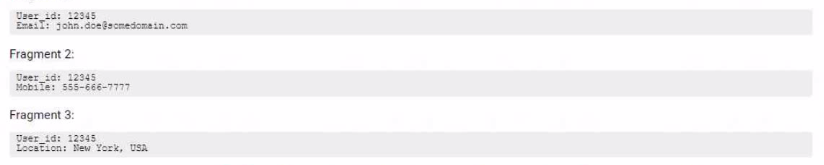
However, upon Inspection of the profile, they realize that only the email from Fragment 1 appears, while mobile and location from Fragments 2 and 3 do not.
What is the most likely reason for the missing data in Real-Time Customer Profile'
Correct : A
In Adobe Real-Time CDP, the Real-Time Customer Profile does not simply aggregate every piece of data ingested into the system by default. Instead, it utilizes Merge Policies to determine which datasets are 'trusted' and should contribute to the final, unified view of a customer. Even if data is successfully ingested into a dataset and correctly linked via a primary identity like user_id, it will not appear in the unified profile if the source dataset is not included in the active Merge Policy.
When the data engineer observes that attributes from Fragment 2 (Mobile) and Fragment 3 (Location) are missing while Fragment 1 (Email) is present, the most probable cause is that the datasets containing Fragments 2 and 3 have not been added to the Dataset Precedence or are not part of the union governed by the specific Merge Policy being viewed. In AEP, you can create multiple Merge Policies for different use cases; if the UI is set to a policy that only includes the 'Email System' dataset, other attributes will remain hidden from that specific profile view.
Options B and C are incorrect because the Real-Time Customer Profile is designed to be eventually consistent and non-linear; the system handles fragments loaded at different times or in different orders by constantly re-evaluating the profile as new data arrives. Option D is factually incorrect, as Mobile and Location are standard attributes within XDM. Therefore, ensuring the datasets are correctly enabled for Profile and included in the relevant Merge Policy is the critical step for data visibility.
Start a Discussions
Submit Your Answer:
Question 2
A company wants to capture both customer_id and email_address as identities in their data feeds within the Real-Time customer profile. What is the recommended identity types that should be used for the identities listed above?
Correct : A
In Adobe Experience Platform, Identity Namespaces are used to categorize the types of identities that distinguish an individual across various channels and devices. When modeling data for the Real-Time Customer Profile, selecting the correct Identity Type is fundamental for accurate profile stitching and the integrity of the identity graph.
customer_id (Cross-Device ID): A customer_id is typically an internal, durable identifier assigned by a brand (such as a CRM ID or Loyalty ID). Since this ID remains constant regardless of the hardware or browser the user utilizes, it is classified as a Cross-Device ID. This classification allows the Identity Service to link multiple device-specific IDs (like ECIDs) to a single, stable person-level identifier, facilitating a unified cross-channel view.
email_address (Email): For an email address, the recommended type is Email. This is an out-of-the-box identity type optimized for handling string-based email identifiers. It is often the primary key used for marketing orchestration and cross-device identification when a user authenticates.
Using Cookie ID or Device ID for a customer_id would be technically inaccurate, as those are transient or hardware-bound. Person ID is a conceptual term rather than a standard identity type used for internal CRM IDs in the platform's namespace configuration. By correctly assigning Cross-Device ID to the internal ID and Email to the email field, developers ensure that the Identity Service can effectively perform 'identity stitching' to merge data fragments into a cohesive profile.
Start a Discussions
Submit Your Answer:
Question 3
A large healthcare company has a legacy system which leverages a relational database management system (RDBMS) to keep track of patient records and has multiple tables that represent different entities like demographics, patient visits, diagnoses, treatments and insurance. The company is planning to use Adobe Real-Time Customer Data Platform (Adobe Real-Time CDP) to consolidate all their patient data and help in deriving meaningful insights. They plan to use Adobe Real-Time CDP to translate their RDBMS data model to Experience Data Model (XDM) for ease of data management and real-time analytics. However, they need to ensure that they translate their data model optimally to take full advantage of Adobe Real-Time CDP's features while keeping consistency and data integrity. Considering the data relations, which approach would the data architect adopt to best migrate RDBMS data into XDM?
Correct : C
Migrating from a highly normalized RDBMS to Adobe Real-Time CDP requires transitioning from a 'table-join' mindset to a Profile-plus-Behavior model. In Adobe Experience Platform, the core of the NoSQL architecture is the Real-Time Customer Profile, which is assembled from two distinct types of data: attributes and events.
The optimal approach (Option C) involves creating an XDM Individual Profile schema to act as the 'source of truth' for slow-changing patient demographics (e.g., name, DOB, insurance ID). Simultaneously, time-series data such as patient visits, diagnoses, and treatments should be modeled using the XDM ExperienceEvent class. Unlike an RDBMS where you might link five tables via foreign keys, XDM uses Primary Identities and the Identity Service to 'stitch' these events to the profile in real-time.
Option A is technically incorrect because 'demographics' and 'patient events' are not the names of the base classes (the classes are XDM Individual Profile and XDM ExperienceEvent). Option B (monolithic) would create a massive, non-performant record that fails to capture the chronological nature of healthcare visits. Option D is incorrect because Adobe Experience Platform does not support traditional SQL composite keys for linking schemas; instead, it relies on a flattened, denormalized event structure or Lookup Relationships. By using a Profile-Event architecture, the healthcare provider can perform real-time segmentation (e.g., 'Patients with Diagnosis X who visited in the last 24 hours') with extreme efficiency.
Start a Discussions
Submit Your Answer:
Question 4
A marketer is using Adobe Real-Time CDP and wants to exclude potential customers who have already made a purchase in the last 30 days from being targeted in an upcoming holiday discount campaign. What criterion would the marketer use to create the audience segment for the campaign?
Correct : C
To effectively exclude a group from a campaign in Adobe Real-Time CDP, the marketer first needs to define the group they wish to suppress. The most efficient way to achieve this in the Segment Builder is to create an audience of 'Recent Purchasers.' By selecting the criterion 'Segment all profiles who have completed a purchase in last 30 days' (Option C), the marketer creates a dynamic list of individuals who have triggered a commerce purchase event within the specified lookback window.
Once this 'Recent Purchasers' segment is created, the marketer can then use it as an exclusion rule in the main campaign segment. For example, the campaign audience would be defined as: 'All Customers' EXCLUDE 'Recent Purchasers.' This approach is a standard best practice for optimizing marketing spend and preventing customer fatigue.
Option A is incorrect because 'not completed a purchase' is a negative lookback that is computationally more expensive and less precise than identifying a positive action for exclusion. Option B is irrelevant to the purchase history requirement. Option D would exclude browsers, not just purchasers, which would likely over-suppress the audience. By building a positive segment of those who have purchased, the marketer can reuse that segment for different purposes (such as a 'Thank You' campaign) while simultaneously using it as a suppression list for the holiday discount.
Start a Discussions
Submit Your Answer:
Question 5
A system admin is looking to implement attribute-based access control (ABAC) in their Adobe Real-Time CDP (RTCDP) to support unique data access requirements for various user groups within the organization. Which method represents the most efficient way to set up ABAC in RTCDP?
Correct : D
The most efficient implementation of Attribute-Based Access Control (ABAC) in Adobe Real-Time CDP relies on the metadata-driven relationship between data labels and user permissions. Unlike traditional security models that only look at who the user is, ABAC looks at the attributes of the data itself to determine access.
The process begins by applying custom labels to specific XDM schema fields or attributes (Option D). For example, fields containing sensitive contact information can be labeled as 'Protected.' The admin then creates Access Groups and defines Policies that link these labels to specific roles. If a user belongs to a group that does not have the 'Protected' permission, the system will automatically mask or hide those specific fields across the entire UI, including Profile views and Query Service results.
Option A is inefficient because it leads to 'policy sprawl' and is difficult to maintain at scale. Option B is incorrect as AEP is a single, unified data store; you cannot 'distribute' data into different databases to manage access. Option C describes a maintenance task for RBAC but does not address the foundational logic of ABAC. By tying labels to access groups, the admin creates a scalable, dynamic security model where access is automatically enforced based on the nature of the data being accessed.
Start a Discussions
Submit Your Answer:
Want to Unlock Everything for
Adobe AD0-E605 Exam?
Adobe AD0-E605 Exam?
By upgrading to Premium Access, you’ll instantly unlock:
Unlock 68 Premium Questions
-
Exam Name: Adobe Real-Time Customer Data Profile Developer Expert
-
Exam Code: AD0-E605
-
Last Update: 24-Aug-2026
-
Formats: PDF, Web-based,
Desktop Practice -
24/7 Customer Support
 Price: $59 (PDF Format)