 Unlock
Page: 1
/
27
Total 135 questions
Unlock Your Databricks Potential: Master Databricks Certified Associate Developer for Apache Spark 3.5 - Python Now!
Question 1
28 of 55.
A data analyst builds a Spark application to analyze finance data and performs the following operations:
filter, select, groupBy, and coalesce.
Which operation results in a shuffle?
Correct : C
In Spark, a shuffle occurs when data needs to be redistributed across partitions or nodes, typically due to operations that require grouping, joining, or sorting.
groupBy triggers a shuffle because it aggregates data based on key values, requiring data from multiple partitions to be moved across the cluster.
Operations like filter and select are narrow transformations (no shuffle).
coalesce can reduce the number of partitions without a full shuffle (unlike repartition).
Why the other options are incorrect:
A (filter) -- Narrow transformation, no shuffle.
B (select) -- Simple projection, no data movement.
D (coalesce) -- Reduces partitions locally without shuffle.
Spark Architecture --- Transformations and Actions; narrow vs. wide transformations.
Databricks Exam Guide (June 2025): Section ''Apache Spark Architecture and Components'' --- explains shuffle operations and execution hierarchy.
===========
Start a Discussions
Submit Your Answer:
Question 2
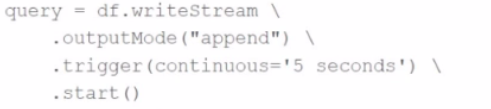
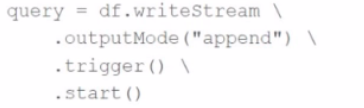
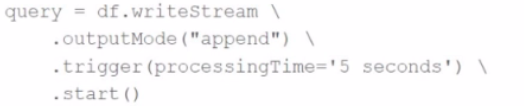
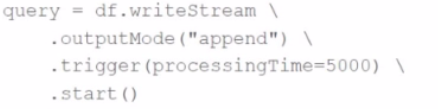
A data engineer is working on a real-time analytics pipeline using Apache Spark Structured Streaming. The engineer wants to process incoming data and ensure that triggers control when the query is executed. The system needs to process data in micro-batches with a fixed interval of 5 seconds.
Which code snippet the data engineer could use to fulfil this requirement?
A)
B)
C)
D)
Options:
Correct : C
To define a micro-batch interval, the correct syntax is:
query = df.writeStream \
.outputMode('append') \
.trigger(processingTime='5 seconds') \
.start()
This schedules the query to execute every 5 seconds.
Continuous mode (used in Option A) is experimental and has limited sink support.
Option D is incorrect because processingTime must be a string (not an integer).
Option B triggers as fast as possible without interval control.
Start a Discussions
Submit Your Answer:
Question 3
A data engineer has been asked to produce a Parquet table which is overwritten every day with the latest data. The downstream consumer of this Parquet table has a hard requirement that the data in this table is produced with all records sorted by the market_time field.
Which line of Spark code will produce a Parquet table that meets these requirements?
A.
final_df \
.sort("market_time") \
.write \
.format("parquet") \
.mode("overwrite") \
.saveAsTable("output.market_events")
B.
final_df \
.orderBy("market_time") \
.write \
.format("parquet") \
.mode("overwrite") \
.saveAsTable("output.market_events")
C.
final_df \
.sort("market_time") \
.coalesce(1) \
.write \
.format("parquet") \
.mode("overwrite") \
.saveAsTable("output.market_events")
D.
final_df \
.sortWithinPartitions("market_time") \
.write \
.format("parquet") \
.mode("overwrite") \
.saveAsTable("output.market_events")
Correct : D
To ensure that data written out to disk is sorted, it is important to consider how Spark writes data when saving to Parquet tables. The methods .sort() or .orderBy() apply a global sort but do not guarantee that the sorting will persist in the final output files unless certain conditions are met (e.g. a single partition via .coalesce(1) --- which is not scalable).
Instead, the proper method in distributed Spark processing to ensure rows are sorted within their respective partitions when written out is:
.sortWithinPartitions('column_name')
According to Apache Spark documentation:
'sortWithinPartitions() ensures each partition is sorted by the specified columns. This is useful for downstream systems that require sorted files.'
This method works efficiently in distributed settings, avoids the performance bottleneck of global sorting (as in .orderBy() or .sort()), and guarantees each output partition has sorted records --- which meets the requirement of consistently sorted data.
Thus:
Option A and B do not guarantee the persisted file contents are sorted.
Option C introduces a bottleneck via .coalesce(1) (single partition).
Option D correctly applies sorting within partitions and is scalable.
Start a Discussions
Submit Your Answer:
Question 4
A data engineer is running a batch processing job on a Spark cluster with the following configuration:
10 worker nodes
16 CPU cores per worker node
64 GB RAM per node
The data engineer wants to allocate four executors per node, each executor using four cores.
What is the total number of CPU cores used by the application?
Correct : C
If each of the 10 nodes runs 4 executors, and each executor is assigned 4 CPU cores:
Executors per node = 4
Cores per executor = 4
Total executors = 4 * 10 = 40
Total cores = 40 executors * 4 cores = 160 cores
However, Spark uses 1 core for overhead on each node when managing multiple executors. Thus, the practical allocation is:
Total usable executors = 4 executors/node 10 nodes = 40
Total cores = 4 cores 40 executors = 160
Answe r : A --- but the question asks specifically about ''CPU cores used by the application,'' assuming all
However, if you are considering 4 executors/node 4 cores = 16 cores per node, across 10 nodes, that's 160.
Final Answe r: A
Start a Discussions
Submit Your Answer:
Question 5
5 of 55.
What is the relationship between jobs, stages, and tasks during execution in Apache Spark?
Correct : D
In Apache Spark's execution hierarchy, the relationships are structured as follows:
Job: Created when an action (e.g., count(), collect(), save()) is triggered on an RDD or DataFrame.
Stage: Each job is divided into one or more stages, separated by shuffle boundaries (e.g., after a reduceByKey or join).
Task: Each stage consists of multiple tasks, one per partition, executed in parallel on executors.
Execution Hierarchy:
Job Stage(s) Task(s)
So, a job contains multiple stages, and each stage contains multiple tasks.
Why the other options are incorrect:
A: A job does not directly contain tasks without stages.
B: A stage cannot contain multiple jobs; it belongs to a single job.
C: Tasks do not contain jobs.
Reference (Databricks Apache Spark 3.5 -- Python / Study Guide):
Spark Architecture Overview --- Execution Hierarchy: Jobs, Stages, and Tasks.
Databricks Exam Guide (June 2025): Section ''Apache Spark Architecture and Components'' --- describes execution hierarchy and lazy evaluation.
===========
Start a Discussions
Submit Your Answer:
Want to Unlock Everything for
Databricks Certified Associate Developer for Apache Spark 3.5 Exam?
Databricks Certified Associate Developer for Apache Spark 3.5 Exam?
By upgrading to Premium Access, you’ll instantly unlock:
Unlock 135 Premium Questions
- Exam Name: Databricks Certified Associate Developer for Apache Spark 3.5 - Python
- Exam Code: Databricks-Certified-Associate-Developer-for-Apache-Spark-3.5
- Last Update: 18-Jul-2026
- Formats: PDF, Web-based,
Desktop Practice - 24/7 Customer Support
 Price: $59 (PDF Format)