 Unlock
Page: 1
/
47
Total 231 questions
Latest Databricks Certified Data Engineer Associate Exam Practice Questions and Answers
Ready to conquer the Databricks-Certified-Data-Engineer-Associate exam and skyrocket your career? Our cutting-edge practice questions are your secret weapon. Crafted by industry experts, they simulate the real exam experience, helping you tackle even the trickiest scenarios with confidence. Whether you prefer PDF flexibility, web-based convenience, or desktop software power, we've got you covered. Don't let imposter syndrome hold you back join thousands of successful candidates who've aced the exam using our materials. With the booming demand for Databricks professionals, your certification could be the key to unlocking dream roles in big data, cloud computing, and AI. Time's ticking, and top positions are filling fast. Invest in your future today and transform from exam anxiety to Databricks authority!
Question 1
Which of the following is stored in the Databricks customer's cloud account?
Correct : D
The only option that is stored in the Databricks customer's cloud account is data. Data is stored in the customer's cloud storage service, such as AWS S3 or Azure Data Lake Storage. The customer has full control and ownership of their data and can access it directly from their cloud account.
Option A is not correct, as the Databricks web application is hosted and managed by Databricks on their own cloud infrastructure. The customer does not need to install or maintain the web application, but only needs to access it through a web browser.
Option B is not correct, as the cluster management metadata is stored and managed by Databricks on their own cloud infrastructure. The cluster management metadata includes information such as cluster configuration, status, logs, and metrics. The customer can view and manage their clusters through the Databricks web application, but does not have direct access to the cluster management metadata.
Option C is not correct, as the repos are stored and managed by Databricks on their own cloud infrastructure. Repos are version-controlled repositories that store code and data files for Databricks projects. The customer can create and manage their repos through the Databricks web application, but does not have direct access to the repos.
Option E is not correct, as the notebooks are stored and managed by Databricks on their own cloud infrastructure. Notebooks are interactive documents that contain code, text, and visualizations for Databricks workflows. The customer can create and manage their notebooks through the Databricks web application, but does not have direct access to the notebooks.
[Databricks Notebooks]
[Databricks Data Engineer Professional Exam Guide]
Start a Discussions
Submit Your Answer:
Question 2
Which of the following describes the relationship between Gold tables and Silver tables?
Correct : A
According to the medallion lakehouse architecture, gold tables are the final layer of data that powers analytics, machine learning, and production applications. They are often highly refined and aggregated, containing data that has been transformed into knowledge, rather than just information. Silver tables, on the other hand, are the intermediate layer of data that represents a validated, enriched version of the raw data from the bronze layer. They provide an enterprise view of all its key business entities, concepts and transactions, but they may not have all the aggregations and calculations that are required for specific use cases. Therefore, gold tables are more likely to contain aggregations than silver tables.Reference:
What is the medallion lakehouse architecture?
What is a Medallion Architecture?
Start a Discussions
Submit Your Answer:
Question 3
Which of the following describes the storage organization of a Delta table?
Mark Question:
Start a Discussions
Submit Your Answer:
Question 4
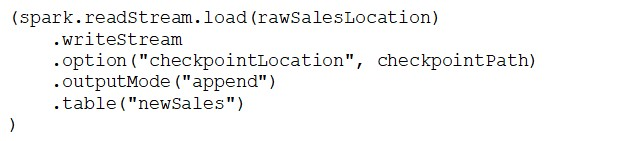
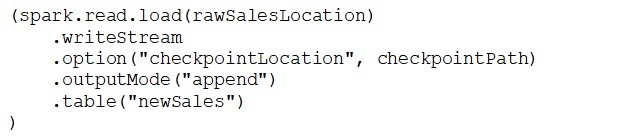
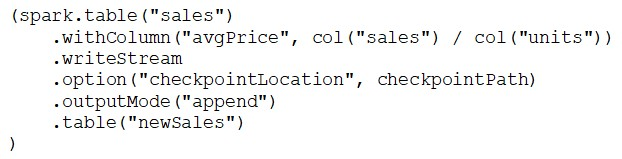
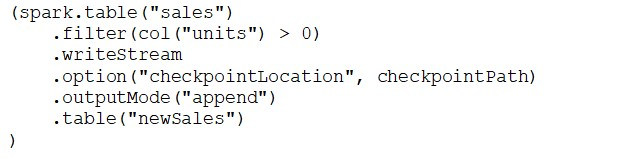
Which of the following Structured Streaming queries is performing a hop from a Silver table to a Gold table?
A.
B.
C.
D.
E.
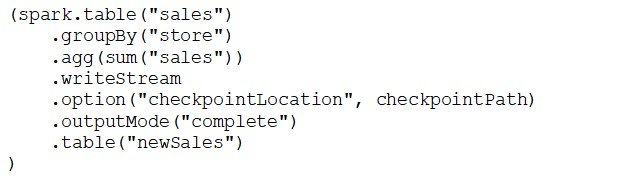
Correct : E
The best practice is to use 'Complete' as output mode instead of 'append' when working with aggregated tables. Since gold layer is work final aggregated tables, the only option with output mode as complete is option E.
Start a Discussions
Submit Your Answer:
Question 5
Which of the following commands can be used to write data into a Delta table while avoiding the writing of duplicate records?
Start a Discussions
Submit Your Answer:
Want to Unlock Everything for
Databricks Certified Data Engineer Associate Exam?
Databricks Certified Data Engineer Associate Exam?
By upgrading to Premium Access, you’ll instantly unlock:
Unlock 231 Premium Questions
-
Exam Name: Databricks Certified Data Engineer Associate Exam
-
Exam Code: Databricks-Certified-Data-Engineer-Associate
-
Last Update: 06-Sep-2026
-
Formats: PDF, Web-based,
Desktop Practice -
24/7 Customer Support
 Price: $59 (PDF Format)