 Unlock
Page: 1
/
15
Total 74 questions
Latest Databricks Machine Learning Associate Exam Practice Questions and Answers
Aspiring data wizards, your journey to Databricks mastery starts here! Unlock the power of machine learning with our revolutionary Databricks-Machine-Learning-Associate study materials. We've distilled years of expertise into laser-focused practice questions, available in PDF, web-based, and desktop formats to suit your learning style. Don't let exam anxiety hold you back our comprehensive prep tools are your secret weapon for conquering the Databricks Certified Machine Learning Associate Exam. Join thousands of successful candidates who've leveraged our resources to land coveted roles in AI and big data. With real-world scenarios and up-to-the-minute content, you'll be ready to tackle Spark, MLflow, and advanced analytics with confidence. Time's ticking seize this opportunity to transform your career and become the ML expert companies are scrambling to hire. Your future in cutting-edge technology awaits!
Question 1
A machine learning engineer is using the following code block to scale the inference of a single-node model on a Spark DataFrame with one million records:

Assuming the default Spark configuration is in place, which of the following is a benefit of using an Iterator?
Correct : C
Using an iterator in the pandas_udf ensures that the model only needs to be loaded once per executor rather than once per batch. This approach reduces the overhead associated with repeatedly loading the model during the inference process, leading to more efficient and faster predictions. The data will be distributed across multiple executors, but each executor will load the model only once, optimizing the inference process.
Databricks documentation on pandas UDFs: Pandas UDFs
Start a Discussions
Submit Your Answer:
Question 2
A data scientist is using Spark ML to engineer features for an exploratory machine learning project.
They decide they want to standardize their features using the following code block:
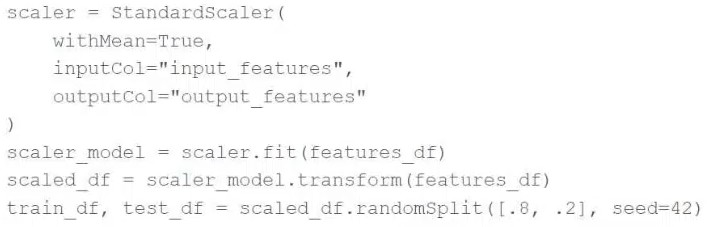
Upon code review, a colleague expressed concern with the features being standardized prior to splitting the data into a training set and a test set.
Which of the following changes can the data scientist make to address the concern?
Correct : E
To address the concern about standardizing features prior to splitting the data, the correct approach is to use the Pipeline API to ensure that only the training data's summary statistics are used to standardize the test data. This is achieved by fitting the StandardScaler (or any scaler) on the training data and then transforming both the training and test data using the fitted scaler. This approach prevents information leakage from the test data into the model training process and ensures that the model is evaluated fairly. Reference:
Best Practices in Preprocessing in Spark ML (Handling Data Splits and Feature Standardization).
Start a Discussions
Submit Your Answer:
Question 3
A data scientist has created two linear regression models. The first model uses price as a label variable and the second model uses log(price) as a label variable. When evaluating the RMSE of each model by comparing the label predictions to the actual price values, the data scientist notices that the RMSE for the second model is much larger than the RMSE of the first model.
Which of the following possible explanations for this difference is invalid?
Correct : E
The Root Mean Squared Error (RMSE) is a standard and widely used metric for evaluating the accuracy of regression models. The statement that it is invalid is incorrect. Here's a breakdown of why the other statements are or are not valid:
Transformations and RMSE Calculation: If the model predictions were transformed (e.g., using log), they should be converted back to their original scale before calculating RMSE to ensure accuracy in the evaluation. Missteps in this conversion process can lead to misleading RMSE values.
Accuracy of Models: Without additional information, we can't definitively say which model is more accurate without considering their RMSE values properly scaled back to the original price scale.
Appropriateness of RMSE: RMSE is entirely valid for regression problems as it provides a measure of how accurately a model predicts the outcome, expressed in the same units as the dependent variable.
Reference
'Applied Predictive Modeling' by Max Kuhn and Kjell Johnson (Springer, 2013), particularly the chapters discussing model evaluation metrics.
Start a Discussions
Submit Your Answer:
Question 4
A data scientist is attempting to tune a logistic regression model logistic using scikit-learn. They want to specify a search space for two hyperparameters and let the tuning process randomly select values for each evaluation.
They attempt to run the following code block, but it does not accomplish the desired task:

Which of the following changes can the data scientist make to accomplish the task?
Correct : A
The user wants to specify a search space for hyperparameters and let the tuning process randomly select values. GridSearchCV systematically tries every combination of the provided hyperparameter values, which can be computationally expensive and time-consuming. RandomizedSearchCV, on the other hand, samples hyperparameters from a distribution for a fixed number of iterations. This approach is usually faster and still can find very good parameters, especially when the search space is large or includes distributions.
Reference
Scikit-Learn documentation on hyperparameter tuning: https://scikit-learn.org/stable/modules/grid_search.html#randomized-parameter-optimization
Start a Discussions
Submit Your Answer:
Question 5
A machine learning engineer is trying to scale a machine learning pipeline pipeline that contains multiple feature engineering stages and a modeling stage. As part of the cross-validation process, they are using the following code block:
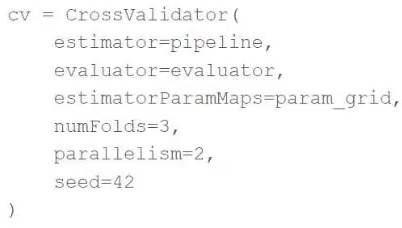
A colleague suggests that the code block can be changed to speed up the tuning process by passing the model object to the estimator parameter and then placing the updated cv object as the final stage of the pipeline in place of the original model.
Which of the following is a negative consequence of the approach suggested by the colleague?
Correct : B
If the model object is passed to the estimator parameter of CrossValidator and the cross-validation object itself is placed as a stage in the pipeline, the feature engineering stages within the pipeline would be applied separately to each training and validation fold during cross-validation. This leads to a significant issue: the feature engineering stages would be computed using validation data, thereby leaking information from the validation set into the training process. This would potentially invalidate the cross-validation results by giving an overly optimistic performance estimate. Reference:
Cross-validation and Pipeline Integration in MLlib (Avoiding Data Leakage in Pipelines).
Start a Discussions
Submit Your Answer:
Want to Unlock Everything for
Databricks Machine Learning Associate Exam?
Databricks Machine Learning Associate Exam?
By upgrading to Premium Access, you’ll instantly unlock:
Unlock 74 Premium Questions
-
Exam Name: Databricks Certified Machine Learning Associate Exam
-
Exam Code: Databricks-Machine-Learning-Associate
-
Last Update: 02-Sep-2026
-
Formats: PDF, Web-based,
Desktop Practice -
24/7 Customer Support
 Price: $59 (PDF Format)