 Unlock
Page: 1
/
10
Total 50 questions
Actual HPE7-J02 Practice Exam – Updated Questions 2026
Ready to elevate your storage integration expertise and unlock new career opportunities? Our comprehensive HPE7-J02 practice questions are your secret weapon for acing the Advanced HPE Storage Integrator Solutions Written Exam. Crafted by industry veterans, our materials go beyond mere memorization, diving deep into real-world scenarios you'll face on the job. Whether you prefer studying on-the-go with our PDF version, enjoy interactive learning through our web-based platform, or want the robust features of our desktop software, we've got you covered. Don't let exam anxiety hold you back – join thousands of successful IT professionals who've trusted our proven study system. With cutting-edge storage technologies evolving rapidly, certification is your ticket to becoming an indispensable asset in data center optimization. Seize this opportunity to distinguish yourself in the competitive world of enterprise storage solutions. Your future in HPE integration mastery starts here!
Question 1
Which statement is correct when enabling port trunking (FC ISL / Ethernet link aggregation)?
Correct : B
Detailed Explanatio n:
Rationale for Correct Answe r:
In B-Series (Brocade) SAN switches, trunking requires that all ports in a trunk group belong to the same port group (same ASIC) and run at the same speed. This ensures frame ordering and load balancing across ISLs.
Distractors:
A: Incorrect --- cable length differences must be minimal, but not stated in meters like this.
C: Incorrect --- speeds must match across all trunked ports.
D: Trunking requires a license on some Brocade models; not always enabled by default.
Key Concept: Port trunking requires same port group and same speed.
Start a Discussions
Submit Your Answer:
Question 2
The storage solution based on the exhibit is deployed at a customer site.
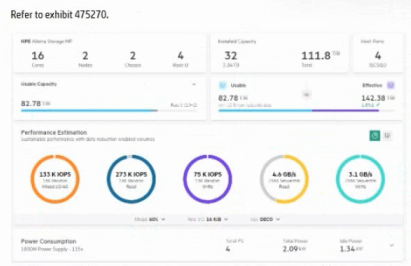
How can the sequential read performance be enhanced with this setup?
Correct : A
Detailed Explanatio n:
Rationale for Correct Answe r:
The exhibit shows an Alletra MP configuration delivering ~4.6 GB/s (256 KB sequential read) with four 10 Gb host ports. That throughput is close to the aggregate front-end bandwidth ceiling of 410 GbE (5 GB/s raw, less with protocol overhead). For large-block sequential workloads, the front-end link budget is often the bottleneck; adding additional 10 GbE ports (or moving to higher-speed links) increases available host bandwidth and raises sustained sequential read throughput. This aligns with HPE sizing guidance: scale host connectivity to meet sequential throughput targets before adding media.
Analysis of Incorrect Options (Distractors):
B: Adding a third node isn't applicable to a 2-node HA block pair and would not address a front-end bandwidth limit.
C: More controller cores don't raise link-level throughput if host I/O is already constrained by port bandwidth.
D: Adding NVMe media primarily boosts IOPS/parallelism; sequential read is bounded here by front-end ports.
Key Concept: Sequential throughput is front-end bandwidth bound; scale host ports to increase GB/s.
Start a Discussions
Submit Your Answer:
Question 3
Which statement is true regarding HPE's SAP HANA solutions?
Correct : D
Detailed Explanatio n:
Rationale for Correct Answe r:
HPE is one of the leading infrastructure providers for SAP HANA, with ~40% of global SAP HANA deployments running on HPE platforms (ProLiant, Alletra, Nimble/Primera for storage). This is an official HPE statistic repeatedly cited in white papers and customer references.
Distractors:
A: SAP HANA licensing is provided directly by SAP, not custom-issued by HPE.
B: Licensing costs are tied to SAP metrics (memory size), not Alletra storage type.
C: ''77% prefer'' is a marketing exaggeration and not the accurate documented figure.
Key Concept: HPE's strong positioning in SAP HANA infrastructure market share.
Start a Discussions
Submit Your Answer:
Question 4
Exhibit shows HPE StoreOnce Catalyst Store Security Settings:
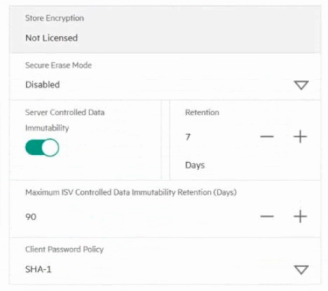
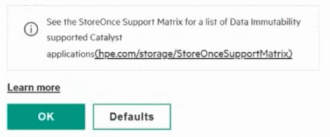
Server Controlled Data Immutability enabled (7 days).
Maximum ISV Controlled Data Immutability Retention (90 days).
Which statement is correct?
Correct : A
Start a Discussions
Submit Your Answer:
Question 5
Refer to the exhibit of Zerto Vault architecture.
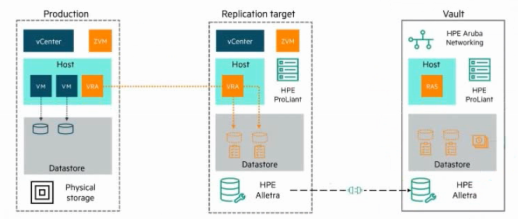
Which statement about the Zerto Vault architecture is correct?
Correct : B
Detailed Explanatio n:
Rationale for Correct Answe r:
In the Zerto Vault architecture, production workloads replicate continuously to a Replication Target (secondary site). From there, data is further replicated periodically and encrypted into the Vault (air-gapped, isolated site). This two-step process ensures ransomware resilience and immutability, as the Vault acts as a hardened third copy.
Distractors:
A: Production-to-replication target traffic is continuous synchronous/asynchronous replication, not periodic. Periodic replication applies to Replication Target Vault.
C: The Resilience Automation Server (RAS) is responsible for orchestrating failover and immutability enforcement, but it does not control port access between production and replication target.
D: Snapshots of Zerto components are not what is replicated --- it's application data VMs/volumes. The Vault ensures immutability of replicated data, not ZVM components.
Key Concept: Zerto Vault = encrypted, periodic replication from replication target to immutable vault.
Start a Discussions
Submit Your Answer:
Want to Unlock Everything for
HPE7-J02 Exam?
HPE7-J02 Exam?
By upgrading to Premium Access, you’ll instantly unlock:
Unlock 50 Premium Questions
-
Exam Name: Advanced HPE Storage Integrator Solutions Written Exam
-
Exam Code: HPE7-J02
-
Last Update: 26-Aug-2026
-
Formats: PDF, Web-based,
Desktop Practice -
24/7 Customer Support
 Price: $59 (PDF Format)