 Unlock
Page: 1
/
10
Total 50 questions
Actual HPE7-V01 Practice Exam – Updated Questions 2026
Breaking into hybrid cloud architecture demands more than theory—it requires proven expertise that employers recognize instantly. Our HPE7-V01 practice materials transform anxious candidates into confident professionals ready to design, implement, and optimize HPE edge-to-cloud infrastructures. Whether you're targeting roles as a Cloud Solutions Architect, Infrastructure Specialist, or Hybrid IT Consultant, these meticulously crafted questions mirror real exam scenarios across GreenLake, Aruba networking, and intelligent edge deployments. Choose your learning style: study offline with PDF guides during your commute, sharpen skills through our interactive web platform, or simulate actual testing conditions with desktop software. Join thousands who've accelerated their certification journey—our materials reflect the latest HPE technologies and exam patterns, giving you the strategic advantage in today's competitive IT landscape. Don't let inadequate preparation delay your career breakthrough when comprehensive, multi-format resources are within reach.
Question 1
Your customer has a combination of HPE and non-HPE equipment.
What is the correct functionality available in Aruba Fabric Composer for this customer's environment?
Correct : D
The correct answer is D because Aruba Fabric Composer is designed for data-center fabric automation, especially ArubaOS-CX based spine-leaf and EVPN-VXLAN environments. It discovers data-center infrastructure and automates the provisioning and ongoing configuration of both spine-and-leaf fabrics and Layer 2 two-tier topologies. That makes it directly relevant to customers with mixed HPE and non-HPE environments where repeatable fabric deployment, validation, and operational consistency are required. Option A is incorrect because HPE Alletra Storage MP B10000 management belongs to HPE storage management tools such as Data Services Cloud Console and array-specific integrations, not Aruba Fabric Composer. Option B is incorrect because HPE Synergy Virtual Connect is managed through HPE OneView / Synergy Composer, not Aruba Fabric Composer. Option C is also not the best answer because SAN zoning is normally performed through Fibre Channel SAN fabric tools or storage-networking workflows, not through Aruba Fabric Composer as a generic function of ArubaOS-CX 8400. The exam logic is clear: Fabric Composer's value is accelerating, standardizing, and validating data-center network-fabric provisioning. Reference/topics: Aruba Fabric Composer, data-center fabric automation, ArubaOS-CX, spine-leaf provisioning.
Start a Discussions
Submit Your Answer:
Question 2
Your customer has a networking environment based on Aruba CX 8325 switches configured with Quality of Service settings that give higher priority to iSCSI traffic between HPE ProLiant servers and HPE Alletra 6000 storage. They are planning to add HPE Synergy frames with HPE Virtual Connect modules that will connect to the same Aruba infrastructure.
The frames will be deployed in different VLANs. They need to update their environment to provide a lossless fabric for RoCE traffic that will traverse between the HPE Synergy frames and through multiple switches.
Your customer has two sets of Synergy frames in different logical enclosures connected with Aruba CX 8325 switches. They want to update their environment to provide lossless traffic for RoCE traffic.
What is the correct environmental or design change that will meet the customer's new requirement?
Correct : B
The correct answer is B. In HPE Synergy, network connectivity for compute modules is defined through HPE OneView server profiles. When RoCE is required, the server profile must explicitly include RoCE connections mapped to the appropriate RoCE network. HPE OneView guidance for adding a RoCE network states that server profiles should be created or edited with at least two RoCE connections mapped to the network. That directly supports the customer's requirement for resilient, lossless RDMA connectivity between Synergy frames and the Aruba data-center fabric. Option A is incorrect because RoCEv1 is Layer 2 only and is not appropriate for a design traversing multiple switches and VLAN/routed boundaries. Option C is incomplete because operating-system queue creation alone does not establish Synergy Virtual Connect fabric policy or redundant RoCE connectivity. Option D is technically wrong because RoCE traffic should be consistently classified and lossless behavior must be enforced end to end, not split across two different priority values. Reference/topics: HPE Synergy networking, HPE OneView server profiles, RoCE networks, DCB/lossless Ethernet, Aruba CX data-center fabric.
Start a Discussions
Submit Your Answer:
Question 3
Your customer is considering HPE Alletra 6000 or HPE Alletra Storage MP B10000 for use as a Peer Persistence enabling platform for their critical workloads.
Which statement about these platforms and their benefits is true for Peer Persistence?
Correct : D
The correct answer is D. HPE Alletra Storage MP B10000 supports mission-critical Peer Persistence designs using synchronous Remote Copy, and FC can be used as an underlying Remote Copy transport. HPE material for Active Peer Persistence states that the solution uses Remote Copy synchronous mode, while HPE B10000 training material describes the requirement for synchronous RC links using RCFC or RCIP and cross-site Fibre Channel or iSCSI host SAN connectivity. Options A and B are wrong because Alletra 6000 is associated with Nimble/Alletra 6000 Peer Persistence, not the same Active Peer Persistence model used with Alletra Storage MP B10000, Primera, and Alletra 9000-class arrays. Option C is not the best answer because Active Peer Persistence is a two-array high-availability model; one-to-many Remote Copy is a replication topology and should not be confused with the active-active peer-persistence protection model. The key validated design differentiator here is that B10000 supports FC-based synchronous replication for high-availability block-storage use cases. Reference/topics: HPE Alletra Storage MP B10000, Active Peer Persistence, Remote Copy, mission-critical storage design.
Start a Discussions
Submit Your Answer:
Question 4
Your customer is planning a Scality RING solution. Approximately 750 TB of data must be stored on the SDS. The customer prefers SSD or NVMe drives.
What is true regarding this solution?
Correct : A
The correct answer is A because Scality RING is positioned by HPE as a scale-out object and file storage solution built on qualified HPE server platforms, including HPE Alletra Storage Server models. For a customer planning approximately 750 TB of usable software-defined storage, the design focus is the validated HPE server configuration, drive type, usable-capacity target, and Scality license sizing. HPE documentation describes the Scality RING solution as consisting of HPE server systems, Scality license and maintenance, and installation services, with licensing based on unique usable data capacity. The minimum RING configuration is not 1000 TB; HPE references a lower starting usable-capacity threshold, so option B is incorrect. Option D is also incorrect because Scality solutions and licenses are explicitly available through HPE solution packaging. Option C is not the best design statement for this customer use case because the key technical validation is platform support and capacity alignment, not a generic claim about lower-cost licensing. This maps directly to the course topic covering scale-out unstructured data platforms, including Scality, Qumulo, Cohesity, and related HPE storage-server designs.
Start a Discussions
Submit Your Answer:
Question 5
Your customer has requested a solution with HPE Alletra Storage MP B10000 that needs four SFP28 ports per node, for iSCSI connectivity.
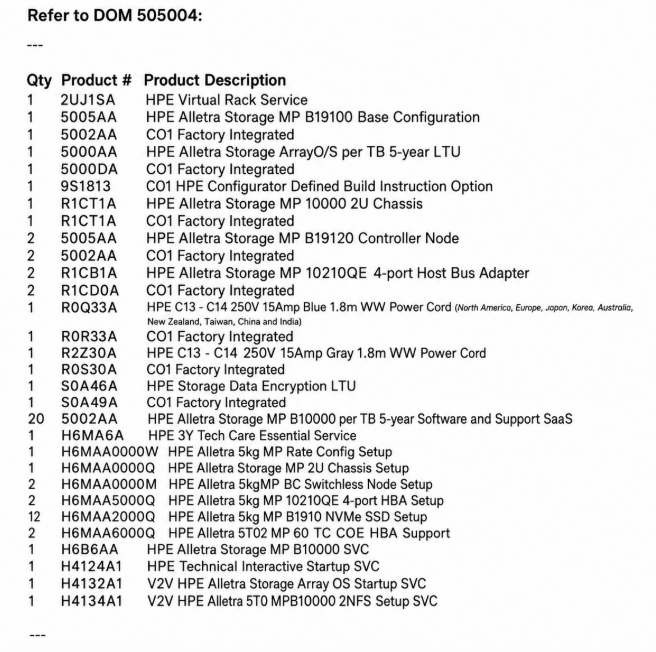
A junior architect has prepared a BOM for the solution.
What needs to be changed in the BOM to meet the requirement?
Correct : C
The correct answer is C. The customer requirement is explicit: four SFP28 iSCSI ports per controller node. An HPE Alletra Storage MP B10000 controller pair has two nodes, so the design requires eight usable SFP28 optical connections in total when all four 25GbE ports on each node are to be populated. The BOM already includes the Ethernet host bus adapters required for the iSCSI personality; the gap is the number of optical transceivers. HPE Alletra Storage MP B10000 supports host-port configuration by node, and HPE QuickSpecs list host port limits by controller model. HPE also identifies the 10/25GbE 4-port Host Bus Adapter as the correct Ethernet HBA class for Alletra Storage MP connectivity, while the Q2P64B item is the 25Gb SFP28 short-wave extended-temperature optical transceiver. Option A incorrectly removes the HBAs. Option B adds unnecessary HBAs instead of completing the optics population. Option D replaces adapters unnecessarily when the correct Ethernet HBA capacity is already present. The required correction is to add the missing four SFP28 transceivers so that all eight 25GbE ports can be used for iSCSI. Reference/topics: B10000 host-port sizing, iSCSI connectivity, SFP28 transceiver validation, BOM review.
Start a Discussions
Submit Your Answer:
Want to Unlock Everything for
HPE7-V01 Exam?
HPE7-V01 Exam?
By upgrading to Premium Access, you’ll instantly unlock:
Unlock 50 Premium Questions
-
Exam Name: Advanced HPE Edge-to-Cloud Solutions
-
Exam Code: HPE7-V01
-
Last Update: 04-Sep-2026
-
Formats: PDF, Web-based,
Desktop Practice -
24/7 Customer Support
 Price: $59 (PDF Format)