 Unlock
Page: 1
/
10
Total 50 questions
Master Oracle Java SE 17 Developer with Our 1Z0-829 Prep Arsenal
Question 1
Daylight Saving Time (DST) is the practice of advancing clocks at the start of spring by one hour and
adjusting them backward by one hour in autumn.
Considering that in 2021, DST in Chicago (Illinois) ended on November 7th at 2 AM, and given the fragment:
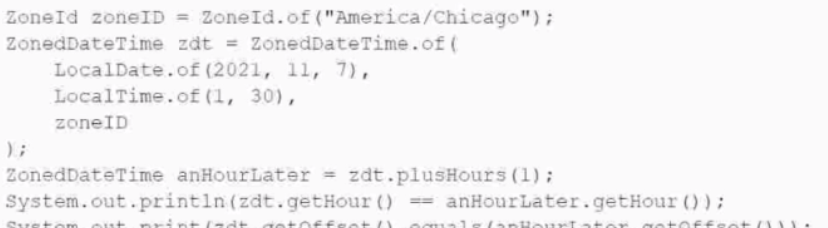
What is the output?
Correct : A
The answer is A because the code fragment uses the ZoneId and ZonedDateTime classes to create two date-time objects with the same local date-time but different zone offsets. The ZoneId class represents a time-zone ID, such as America/Chicago, and the ZonedDateTime class represents a date-time with a time-zone in the ISO-8601 calendar system. The code fragment creates two ZonedDateTime objects with the same local date-time of 2021-11-07T01:30, but different zone IDs of America/Chicago and UTC. The code fragment then compares the two objects using the equals and isEqual methods.
The equals method compares the state of two objects for equality. In this case, it compares the local date-time, zone offset, and zone ID of the two ZonedDateTime objects. Since the zone offsets and zone IDs are different, the equals method returns false.
The isEqual method compares the instant of two temporal objects for equality. In this case, it compares the instant of the two ZonedDateTime objects, which is derived from the local date-time and zone offset. Since DST in Chicago ended on November 7th at 2 AM in 2021, the local date-time of 2021-11-07T01:30 in America/Chicago corresponds to the same instant as 2021-11-07T06:30 in UTC. Therefore, the isEqual method returns true.
Hence, the output is true false.Reference:
Oracle Certified Professional: Java SE 17 Developer
OCP Oracle Certified Professional Java SE 17 Developer Study Guide
ZonedDateTime (Java Platform SE 8 )
Time Zone & Clock Changes in Chicago, Illinois, USA
Daylight Saving Time Changes 2023 in Chicago, USA
Start a Discussions
Submit Your Answer:
Question 2
Given:

What is the result?
Correct : E
The answer is E because the code fragment contains several syntax errors that prevent it from compiling. Some of the errors are:
The enum declaration is missing a semicolon after the list of constants.
The enum constants are not capitalized, which violates the Java naming convention for enums.
The switch expression is missing parentheses around the variable name.
The case labels are missing colons after the enum constants.
The default label is missing a break statement, which causes a fall-through to the next case.
The println statement is missing a closing parenthesis and a semicolon.
A possible corrected version of the code fragment is:
enum Vehicle { BICYCLE, CAR, MOTORCYCLE, TRUCK; } public class Test { public static void main(String[] args) { Vehicle v = Vehicle.BICYCLE; switch (v) { case BICYCLE: System.out.print(''1''); break; case CAR: System.out.print(''3''); break; case MOTORCYCLE: System.out.print(''1''); break; case TRUCK: System.out.print(''2''); break; default: System.out.print(''0''); break; } System.out.println(); } }
This would print 1 as the output.Reference:
Oracle Certified Professional: Java SE 17 Developer
OCP Oracle Certified Professional Java SE 17 Developer Study Guide
Start a Discussions
Submit Your Answer:
Question 3
Given the directory structure:
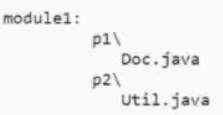
Given the definition of the Doc class:

Which two are valid definition of the wordDoc class?
Start a Discussions
Submit Your Answer:
Question 4
Given the code fragment:
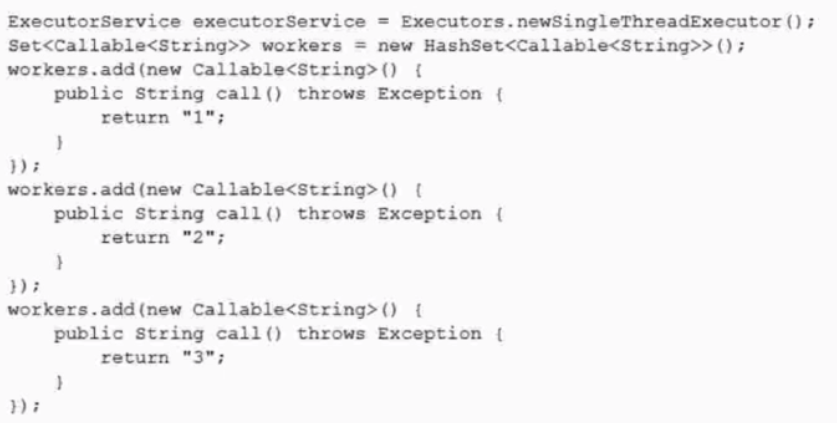
Which code fragment invokes all callable objects in the workers set?
A)

B)

C)

D)

Start a Discussions
Submit Your Answer:
Question 5
Which statement is true about migration?
Correct : B
The answer is B because a bottom-up migration is a strategy for modularizing an existing application by moving its dependencies to the module path one by one, starting from the lowest-level libraries and ending with the application itself. This way, each module can declare its dependencies on other modules using the module-info.java file, and benefit from the features of the Java Platform Module System (JPMS), such as reliable configuration, strong encapsulation, and service loading.
Option A is incorrect because a top-down migration is a strategy for modularizing an existing application by moving it to the module path first, along with its dependencies as automatic modules. Automatic modules are non-modular JAR files that are treated as modules with some limitations, such as not having a module descriptor or a fixed name. A top-down migration allows the application to use the module path without requiring all of its dependencies to be modularized first.
Option C is incorrect because a top-down migration does not require any specific order of migrating modules, as long as the application is moved first and its dependencies are moved as automatic modules. A bottom-up migration, on the other hand, requires the required modules to migrate before the modules that depend on them.
Option D is incorrect because unnamed modules are not automatic modules in any migration strategy. Unnamed modules are modules that do not have a name or a module descriptor, such as classes loaded from the class path or dynamically generated classes. Unnamed modules have unrestricted access to all other modules, but they cannot be accessed by named modules, except through reflection with reduced security checks.Reference:
Oracle Certified Professional: Java SE 17 Developer
OCP Oracle Certified Professional Java SE 17 Developer Study Guide
Migrating to Modules (How and When) - JavaDeploy
Java 9 Modularity: Patterns and Practices for Developing Maintainable Applications
Start a Discussions
Submit Your Answer:
Want to Unlock Everything for
Oracle 1Z0-829 Exam?
Oracle 1Z0-829 Exam?
By upgrading to Premium Access, you’ll instantly unlock:
Unlock 50 Premium Questions
- Exam Name: Java SE 17 Developer
- Exam Code: 1Z0-829
- Last Update: 27-Aug-2026
- Formats: PDF, Web-based,
Desktop Practice - 24/7 Customer Support
 Price: $59 (PDF Format)