 Unlock
Page: 1
/
17
Total 85 questions
Master Oracle Exadata Database Machine X9M Implementation Essentials with Cutting-Edge 1Z0-902 Prep
Question 1
Which are two correct statements for managing virtual deployment using Oracle Exadata Deployment Assistant (OEDA)?
Start a Discussions
Submit Your Answer:
Question 2
Which two statements are true in regards to starting the Exadata Virtual Machine?
Correct : B, E
Statement B is true as the vm_maker ---start-domain command can be used to start a virtual machine manually, as stated in the Oracle Exadata Database Machine X9M Implementation Essentials Official Text Book (page 65).
Start a Discussions
Submit Your Answer:
Question 3
You are adding a disk expansion kit to a running Exadata X8M Database Machine's Database Servers, and have a filesystem layout that includes:
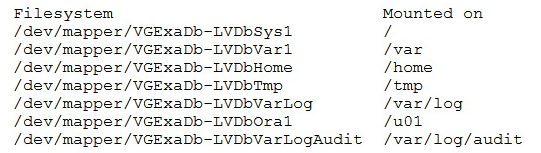
After running the following commands, which command needs to be run to add 20G of space to the filesystem mounted on /u01?

Correct : A
After running the commands above, the filesystem mounted on /u01 is on the logical volume /dev/mapper/VGExaDb-LVDbOral. So, to add 20G of space to the filesystem mounted on /u01, the command that needs to be run is:
lvextend -L +20G --verbose /dev/mapper/VGExaDb-LVDbOral
This command will extend the logical volume /dev/mapper/VGExaDb-LVDbOral by 20 GB of space. It is important to note that the option --verbose is used to display the progress of the operation.
Start a Discussions
Submit Your Answer:
Question 4
Your customer needs to ensure that their data is available on the Exadata machine during updates. The customer wants to be able to update one server at a time but still be protected against single-node server failure.
What ASM redundancy level should they use?
Correct : A
Start a Discussions
Submit Your Answer:
Question 5
You must drop all celldisks on all the storage servers in an X9M-2 quarter rack as part of a reconfiguration project.
Which three statements describe the account on the storage servers which you should use and the tool that may be used to drop the celldisks?
Correct : A, B, F
To drop all celldisks on all the storage servers in an X9M-2 quarter rack, you should use the CELLADMIN account, which has the necessary privileges to perform this task. You can use the CELLCLI command-line interface to drop the celldisks. The best way to do this is by calling CELLCLI on all cells using DCLI (Oracle Database Command Line Interface) which allows you to run commands on multiple servers at once. Alternatively, you can use an administrator-created storage server user with appropriate privileges on celldisk objects by calling CELLCLI on all cells using exadcli. It is not recommended to use the CELLMONITOR account, as it has a more limited set of privileges. It is also important to note that EXACLI is not a valid tool for this task
Start a Discussions
Submit Your Answer:
Want to Unlock Everything for
Oracle 1Z0-902 Exam?
Oracle 1Z0-902 Exam?
By upgrading to Premium Access, you’ll instantly unlock:
Unlock 85 Premium Questions
- Exam Name: Oracle Exadata Database Machine X9M Implementation Essentials
- Exam Code: 1Z0-902
- Last Update: 24-Aug-2026
- Formats: PDF, Web-based,
Desktop Practice - 24/7 Customer Support
 Price: $59 (PDF Format)