 Unlock
Page: 1
/
26
Total 129 questions
Master Salesforce Plat-Arch-204: Platform Integration Architect Exam Prep
Question 1
Northern Trail Outfitters has recently implemented middleware for orchestration of services across platforms. The Enterprise Resource Planning (ERP) system being used requires transactions be captured near real-time at a REST endpoint initiated in Salesforce when creating an Order object. Additionally, the Salesforce team has limited development resources and requires a low-code solution. Which option should fulfill the use case requirements?
Correct : C
To satisfy a requirement for near real-time REST updates with limited development resources, the architect should utilize Flow Builder. Flow Builder is Salesforce's primary low-code tool for automating complex business logic and outbound integrations.
The Remote Process Invocation---Fire and Forget pattern is the most efficient way to signal an external system (or middleware) that a record was created without blocking the user. Using a Record-Triggered Flow on the Order object, the architect can configure an Action (such as an External Service or a simple HTTP Callout) to send the order data to the middleware's REST endpoint.
Option A is slightly incorrect because creating a platform event is just one step in an event-driven flow; the 'Fire and Forget' pattern more accurately describes the end-to-end intent. Option B (Change Data Capture) is a powerful tool, but it is considered a 'pro-code' or high-configuration so12lution on the middleware side, requiring the middleware to manage Replay IDs and Bayeux subscriptions. Option C leverages the native strengths of Flow to fulfill the requirement declaratively, 13allowing the team to14 deliver a functional integration without writing Apex code while meeting the near-real-time performance expectations of the ERP.
Start a Discussions
Submit Your Answer:
Question 2
A large business-to-consumer (B2C) customer is planning to implement Salesforce CRM to become a customer-centric enterprise. Below is the B2C customer's current system landscape diagram.
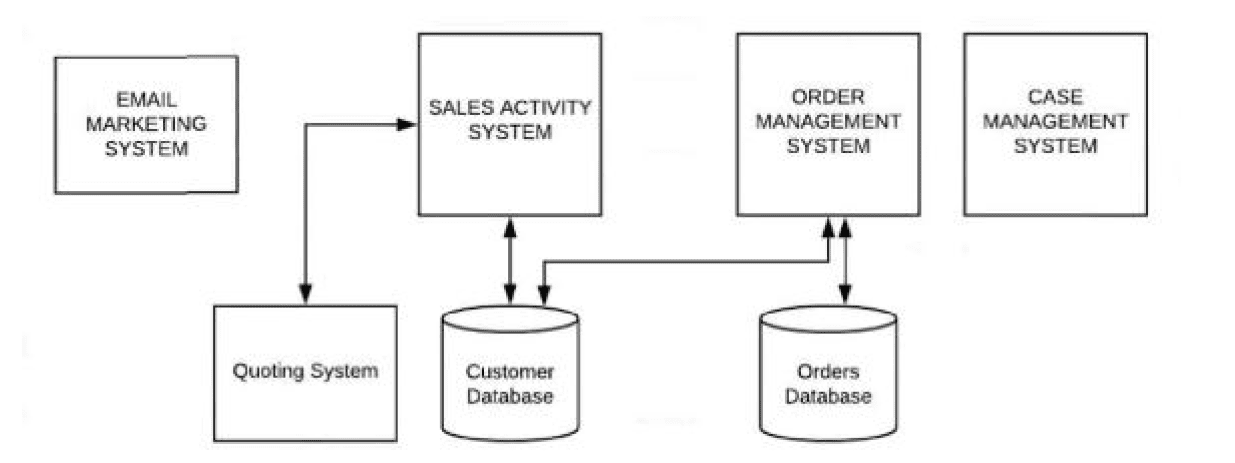
The goals for implementing Salesforce include:
Develop a 360-degree view of the customer.
Leverage Salesforce capabilities for marketing, sales, and service processes.
Reuse Enterprise capabilities built for quoting and order management processes.
Which three systems from the current system landscape can be retired with the implementation of Salesforce?
Correct : A
In the framework of a Salesforce Platform Integration Architect's landscape evaluation, the primary goal is to determine the 'system of record' for each business function and identify redundancies between legacy systems and the proposed Salesforce architecture. This process is driven by the alignment of Salesforce's native 'Customer 360' capabilities with the specific goals defined by the enterprise stakeholders.
According to Goal 2, the customer intends to leverage Salesforce specifically for marketing, sales, and service processes. Within the standard Salesforce ecosystem, these domains are addressed by the three core cloud products:
Marketing Cloud provides the capabilities found in the legacy Email Marketing System.
Sales Cloud replaces the functions of the Sales Activity System.
Service Cloud is the native replacement for the Case Management System.
By migrating these three domains to a single platform, the organization directly fulfills Goal 1---developing a 360-degree view of the customer. Consolidating these interactions onto the Salesforce platform allows for a unified data model where customer behaviors in marketing, sales, and support are visible in one place, eliminating the silos inherent in the previous landscape.
However, a critical constraint is presented in Goal 3, which explicitly mandates the reuse of existing enterprise capabilities for quoting and order management. In an integration architecture, this signals that the Quoting System and Order Management System (OMS) are designated as external systems of record that must remain active. These systems often contain complex logic, tax calculations, or supply chain integrations (such as with an SAP Business Suite) that the business is not currently ready to migrate.
Therefore, since the Quoting and Order Management systems must be retained, they are excluded from the retirement list. The remaining three systems---Email Marketing, Sales Activity, and Case Management---overlap with Salesforce's native strengths and are not protected by the 'reuse' requirement. Retiring them streamlines the technology stack and allows the architect to focus on building robust integration patterns (such as REST or SOAP callouts) to connect Salesforce to the retained Quoting and Order Management systems.
Start a Discussions
Submit Your Answer:
Question 3
The director of customer service at Northern Trail Outfitters (NTO) wants to capture and trend specific business events that occur in Salesforce in real time. The metrics will be accessed in an ad-hoc manner using an external analytics system. The events include product exchanges, authorization clicks, subscription cancellations, and refund initiations via Cases. Which solution should meet these business requirements?
Correct : C
To meet a requirement for real-time event capture that supports an external analytics system, the arc14hitect must choose a pattern that is scalable, decoupled, and reliable. Platform Events are the modern standard for this use case.
By using a Case Trigger to publish a specific Platform Event, NTO creates a highly decoupled Publish/Subscribe architecture. The external analytics system (or a middleware layer feeding it) acts as a subscriber to the event channel. This is superior to standard callouts or outbound messaging for several reasons:
Durability: Platform Events offer a 72-hour retention window. If the analytics system is momentarily offline, it can use the Replay ID to retrieve missed events.
Atomic Transactions: Triggers can be configured to publish events only after the database transaction successfully commits ('Publish After Commit'), ensuring the analytics system doesn't receive data for transactions that were eventually rolled back.
Event Volume: Platform Events are designed to handle much higher volumes of real-time messages than standard synchronous callouts.
Option A (Apex Callouts) is a point-to-point, synchronous pattern that would block Case processing and risk hitting 'Concurrent Long-Running Request' limits. Option B (Outbound Messaging) is reliable but is limited to a single object per message and uses a rigid SOAP format that is less flexible for ad-hoc external analytics than the modern JSON/CometD/gRPC structures used by the event bus. By implementing Option C, the architect ensures that every specific business milestone (refund, exchange, cancellation) is broadcasted immediately, providing the customer service director with the accurate, real-time visibility required for trending and metrics.
Start a Discussions
Submit Your Answer:
Question 4
Northern Trail Outfitters (NTO) uses different shipping services for each of the 34 countries it serves. Services are added and removed frequently. Sales representatives globally need to select between valid service(s) for the customer's country and request shipping estimates. Which solution should an architect propose?
Correct : B
When external services are highly volatile (added/removed frequently), the goal is to decouple the Salesforce UI from the underlying service logic. An Integration Architect should propose invoking a middleware service to retrieve the valid shipping methods.
By using middleware (such as an ESB or MuleSoft) as an abstraction layer, Salesforce doesn't need to 'know' the details of the 34 different shipping providers. When a sales rep selects a country, Salesforce makes a single callout to the middleware. The middleware then performs the routing logic to identify which shippers are active for that region and returns a standardized list to Salesforce.
Option A is a 'maintenance nightmare'; every time a shipping service changes in any of the 34 countries, an admin would need to manually update picklist values and dependencies in Salesforce, which is not scalable. Option C (Platfor31m Events) is an asynchronous pattern unsuitable for a real-time 'request-reply' scenario where a rep is waiting for an estimate during a live customer interaction. Utilizing middleware centralizes the logic, simplifies Salesforce configuration, and allows NTO to change shipping providers without any code deployments or metadata updates in the Salesforce org.
Start a Discussions
Submit Your Answer:
Question 5
Northern Trail Outfitters wants to use Salesforce as a front end for creating accounts using the lead-to-opportunity process. An order is created in Salesforce when the opportunity is Closed/Won, but the back-end Enterprise Resource Planning (ERP) system is the data master for order. The customer wants to be able to see within Salesforce all the stages of order processing like Order Created, Order Shipped, and Order Paid that are within the retention window. Which message durability consideration should an integration architect make when designing a solution to meet these business requirements?
Correct : B
When designing a solution that requires Salesforce to receive and display updates from a back-end ERP (such as order status changes), message durability is a critical factor for ensuring data consistency. In an event-driven architecture using Platform Events or Change Data Capture (CDC), Salesforce utilizes an event bus to handle these incoming notifications.
For high-volume event messages, the Salesforce platform provides a native 72-hour (3-day) retention window. This is a significant architectural advantage for several reasons:
System Resilience: If the Salesforce org or the integration middleware experiences a temporary disruption or is undergoing maintenance, the event messages published by the ERP remain stored in the bus for up to 3 days.
Data Recovery: Once the connection is restored, the subscribing system (Salesforce) can use the Replay ID to catch up on any missed events from the last 72 hours, ensuring that order stages like 'Order Shipped' or 'Order Paid' are not missed.
SLA Management: This 3-day window exceeds the 24-hour limit of older technologies like PushTopics or Outbound Messaging (Option A), providing more breathing room for disaster recovery scenarios.
While ReplayID -1 (Option C) is used to subscribe only to new events published after the subscription starts, it does not address the durability or retention of historical events needed for recovery. By highlighting the 72-hour retention window, the integration architect provides a design that is robust against outages and guarantees that the 'System of Engagement' (Salesforce) stays synchronized with the 'System of Record' (ERP).
Start a Discussions
Submit Your Answer:
Want to Unlock Everything for
Salesforce Plat-Arch-204 Exam?
Salesforce Plat-Arch-204 Exam?
By upgrading to Premium Access, you’ll instantly unlock:
Unlock 129 Premium Questions
- Exam Name: Salesforce Certified Platform Integration Architect
- Exam Code: Plat-Arch-204
- Last Update: 08-Aug-2026
- Formats: PDF, Web-based,
Desktop Practice - 24/7 Customer Support
 Price: $59 (PDF Format)