 Unlock
Page: 1
/
41
Total 204 questions
Master Salesforce Plat-Dev-201: Platform Developer Certification Made Simple
Question 1
(Full question statement)
Universal Containers wants Opportunities to no longer be editable when they reach the Closed/Wonstage.
Which two strategies can a developer use to accomplish this?
Choose 2 answers.
Correct : A, B
Comprehensive and Detailed Explanation From Exact Extract:
A (Correct):AnApproval Processcan lock a record (making it read-only) once the record meets certain criteria like stage = Closed/Won.
B (Correct):AValidation Rulecan prevent users from saving changes when the stage is Closed/Won, by throwing an error.
Example validation formula:
text
CopyEdit
AND(ISCHANGED(StageName), ISPICKVAL(StageName, 'Closed Won'))
Incorrect options:
C:Before triggers run before the record is saved but don't prevent UI-level edits unless combined with DML rollbacks or errors.
D:Auto-response rules are for sending emails, not restricting edits.
This topic relates to bothProcess Automation and Logic (30%)andSecurity and Data Integritypractices.
Start a Discussions
Submit Your Answer:
Question 2
Which two settings must be defined In order to update a record of a junction object?
Choose 2 answers
Correct : B, C
Option B: To update a junction object, the user needsRead/Writeaccess to the primary relationship object.
Option C: The user must also haveRead/Writeaccess on the junction object itself.
:Junction Objects Documentation
Start a Discussions
Submit Your Answer:
Question 3
Provide question feedback here (optional):
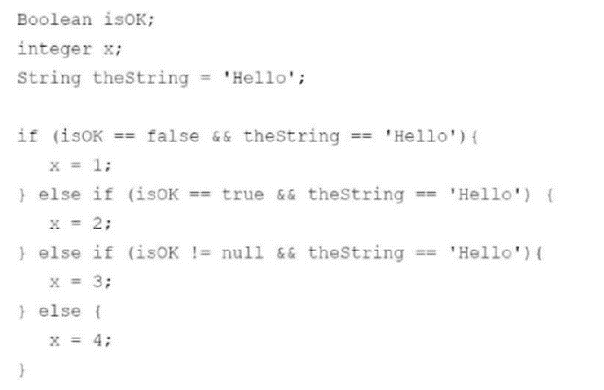
Based on this code, what is the value of x?
Correct : A
The variableisOKis declared but not initialized, so its value isnull. Theif-elseconditions check for specific values ofisOK(trueorfalse), but since it isnull, none of those conditions are satisfied. The program defaults to theelseblock, assigning4tox.
Start a Discussions
Submit Your Answer:
Question 4
A custom Visualforce controller calls the ApexPages.addMessage() method, but no messages are rendering on the page.
Which component should be added to the Visualforce page to display the message?
Correct : B
Option B: The
Not Suitable:
Option A:
Option C:
Option D:
:Visualforce ApexPages Messages
Start a Discussions
Submit Your Answer:
Question 5
A developer created a trigger on a custom object. This custom object also has some dependent pick lists.
According to the order of execution rules, which step happens first?
Correct : A
Order of Execution Rules:
Step 1: Original record is loaded from the database.
Step 2: Field-level validations are performed, including maximum field lengths.
Step 3: Old values are overwritten with new record values.
Step 4: JavaScript validation runs in the browser.
Start a Discussions
Submit Your Answer:
Want to Unlock Everything for
Salesforce Plat-Dev-201 Exam?
Salesforce Plat-Dev-201 Exam?
By upgrading to Premium Access, you’ll instantly unlock:
Unlock 204 Premium Questions
- Exam Name: Salesforce Certified Platform Developer
- Exam Code: Plat-Dev-201
- Last Update: 12-Aug-2026
- Formats: PDF, Web-based,
Desktop Practice - 24/7 Customer Support
 Price: $59 (PDF Format)