 Unlock
Page: 1
/
16
Total 79 questions
Unlock Your VMware Potential: Master Professional Develop VMware Spring 2V0-72.22
Question 1
Which two statements are true regarding @WebMvcTest? (Choose two.)
Correct : A, D
Start a Discussions
Submit Your Answer:
Question 2
Which two statements are true concerning the BeanPostProcessor Extension point? (Choose two.)
Correct : B, D
B . Custom BeanPostProcessors can be implemented for Spring applications.
D . BeanPostProcessors are called during the initialization phase of a bean life cycle.
Start a Discussions
Submit Your Answer:
Question 3
Refer to the exhibit.

The above code shows a conditional @Bean method for the creation of a JdbcTemplate bean. Which two statements correctly describe the code behavior? (Choose two.)
Correct : A, E
The @Bean annotation is used to declare a method that returns an object that should be registered as a bean in the application context. The @ConditionalOnBean annotation is used to specify a condition for the bean creation based on the presence or absence of other beans in the application context. The name attribute of this annotation can be used to specify the bean name or names that must be present or absent for the condition to match. However, this approach is less flexible than using the value or type attribute, which can specify the bean class or classes that must be present or absent for the condition to match. Therefore, it is recommended to use @ConditionalOnBean(DataSource.class) instead of @ConditionalOnBean(name= ''dataSource'') for greater flexibility.
The JdbcTemplate class is a Spring class that simplifies the use of JDBC and helps to avoid common errors. It executes core JDBC workflow, leaving application code to provide SQL and extract results. To create a JdbcTemplate object, we need to pass a DataSource object as a constructor argument. The DataSource interface is a Java interface that represents a factory of connection objects. In this code, the jdbcTemplate() method takes a DataSource object as a parameter and returns a new JdbcTemplate object. This method is annotated with @Bean and @ConditionalOnBean(name= ''dataSource''), which means that it will only create a JdbcTemplate bean when there is already a bean named dataSource in the application context.
Start a Discussions
Submit Your Answer:
Question 4
Which three dependencies are provided by the spring-boot-starter-test? (Choose three.)
Correct : B, D, E
Start a Discussions
Submit Your Answer:
Question 5
Refer to the exhibit.
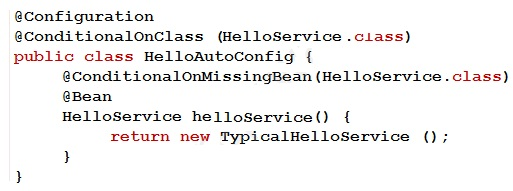
Which two statements are correct regarding the HelloAutoConfig auto-configuration class when it is specified in the META-INF/spring.factories file? (Choose two.)
Correct : B, D
B . A HelloService bean will be created from the helloService() method only when there is no other HelloService bean in the ApplicationContext.
This is true because the @ConditionalOnMissingBean annotation on the helloService() method indicates that this method will only be invoked to create a HelloService bean if there is no existing HelloService bean in the application context. This is a common way to provide a default bean that can be overridden by the user's own bean definition.
D . This auto-configuration class is used only when the HelloService.class is on the classpath.
This is true because the @ConditionalOnClass annotation on the HelloAutoConfig class indicates that this class will only be loaded and processed by Spring Boot if the HelloService.class is present on the classpath. This is a common way to enable auto-configuration for a specific library or feature only when it is available.
Start a Discussions
Submit Your Answer:
Want to Unlock Everything for
VMware 2V0-72.22 Exam?
VMware 2V0-72.22 Exam?
By upgrading to Premium Access, you’ll instantly unlock:
Unlock 79 Premium Questions
- Exam Name: Professional Develop VMware Spring
- Exam Code: 2V0-72.22
- Last Update: 11-Mar-2026
- Formats: PDF, Web-based,
Desktop Practice - 24/7 Customer Support
 Price: $59 (PDF Format)